

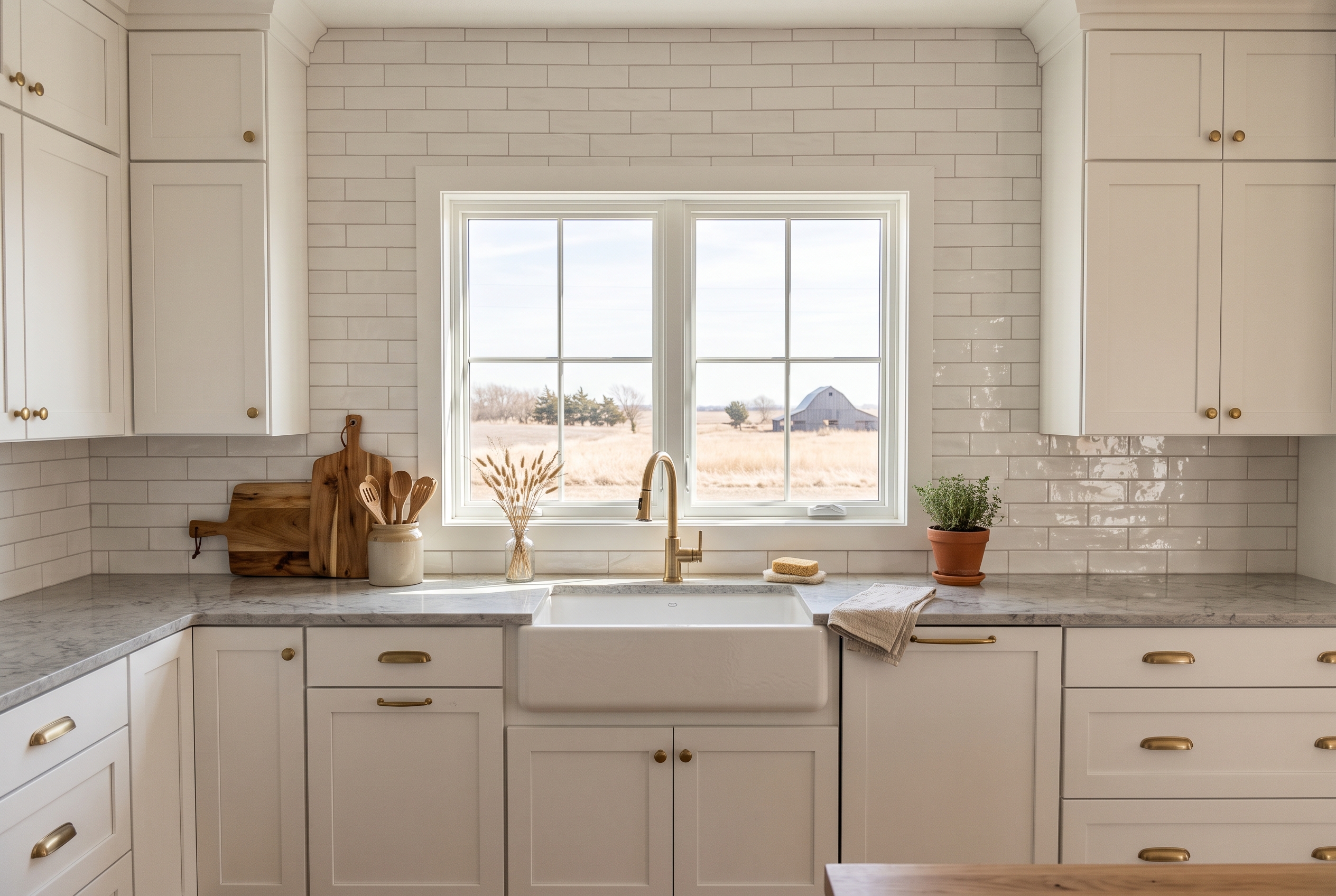
Three things decide the right kitchen backsplash, in this order. The countertop comes first, because the backsplash sits right on top of it and one of the two should carry the pattern. Then how you cook and clean, which decides the material and the grout behind the range and the sink. Last, how far the backsplash runs: a short splash, up to the cabinets, or the whole wall.
With a busy granite or a heavily veined quartz, keep the backsplash quiet. A plain tile in a color pulled from the stone lets the counter be the star.
A plain counter can take a backsplash with pattern or texture. Solid white quartz, butcher block and most laminate leave room for a handmade-look tile, a mosaic or a bold color.
If you cook a lot, choose for cleaning. Larger porcelain tile, glass tile with stain-resistant grout, or a slab of the countertop run up the wall keeps grease out of the joints.
On a budget refresh, plain ceramic subway tile is hard to beat. It costs little, goes with almost any counter, and looks finished.
| Material | Looks | Upkeep | Cost tier |
|---|---|---|---|
| Ceramic | Classic, endless colors | Easy; glaze resists stains | Low |
| Porcelain | Stone and large looks | Easiest tile; dense | Low to mid |
| Glass | Bright, reflects light | Wipes clean; shows spots | Mid to high |
| Natural stone | One of a kind | Seal; no acids | Mid to high |
| Countertop slab | Seamless match | No grout lines | High |
Start with the countertop, then pick the backsplash
Choose the countertop first and the backsplash second, because the backsplash has to match or contrast with a surface you will live with for years. Bring a counter sample, or a photo of it in your kitchen light, when you shop for tile.
The rule that settles most kitchens is that one surface carries the pattern. A busy granite or a quartz with strong veining wants a calm backsplash in one color pulled from the stone, usually its lightest or warmest tone. A plain counter lets the backsplash carry pattern, shape or texture. When both are busy, the kitchen feels restless. When both are plain, it can feel flat, and a textured or glossy tile fixes that.
Lighter or darker comes down to contrast. A backsplash a step lighter than a dark counter keeps the wall from closing in. A white backsplash with a white counter needs texture or a contrasting grout so it does not wash out. Matching on purpose means running the counter material up the wall as a slab.
Look at the cabinets and the hardware too. Warm wood cabinets want a warm white or cream rather than a cold gray, and brass or black hardware can be echoed in a tile's glaze or a metal edge. Tape two or three samples to the wall and look at them in the morning and again at night, because a tile that looks white at noon can look gray under warm bulbs. For choosing the counter itself, see our comparison of quartz, granite and laminate countertops.
Backsplash materials compared
Ceramic and porcelain tile are the right backsplash materials for most kitchens, because they look good, clean easily and cost the least for what they do. Glass, natural stone, a countertop slab and metal each earn their extra cost where their look or their cleaning matters most. Our tile catalog has several hundred tiles to browse.
Ceramic tile
Glazed ceramic is the classic backsplash. The glaze is the stain barrier, so it wipes clean, and the tile is light and easy to cut, which keeps installation simple. It comes in more colors, shapes and handmade-look glazes than any other material. Its softer body can chip at an edge if something hard hits it, which rarely happens on a wall.
Porcelain tile
Porcelain is denser and harder than ceramic, because a tile must absorb less than half a percent of water to be called porcelain. That makes it the toughest tile you can put on a wall. It comes in large formats and in stone and concrete looks, and big tiles mean fewer grout lines to clean. It is heavier and harder to cut, so large porcelain takes a skilled installer.
Glass tile
Glass tile is a good backsplash. It absorbs nothing, it bounces light around the kitchen, and it wipes clean, though it shows fingerprints and water spots more than a matte tile.
Glass is a wall-only material, and it asks more of the installer. It is set in white mortar, because the mortar shows through, and it takes the fine grout that will not scratch it. Its edges need a finished piece or trim. All of that makes installing glass cost more than installing ceramic.
Natural stone tile
Marble, travertine, limestone, slate and granite tile give a backsplash nobody else has. Granite and slate are tough, and most granite needs little or no sealing. Marble, travertine and limestone are softer, need sealing, and react to acids, which leave dull spots called etches. Behind a heavy cook's range, marble picks up a patina, which is a choice to make with your eyes open.
A slab backsplash from the countertop
Running the countertop material up the wall gives a backsplash with no grout lines and a perfect match with the counter, the one case where matching is the point. Cambria's quartz never needs sealing as a backsplash, and Cambria points to the wall behind the range, lined up with the hood, as the place a quartz backsplash becomes the focal point.
A full-height slab costs more per square foot than most tile, and the outlets are cut into it. A 4-inch slab splash cut from the same material is the budget version, and it pairs well with tile on the wall over it.
Metal and other materials
Stainless steel sheet behind a range gives a commercial-kitchen look and wipes down easily. Metal mosaic tile adds shine in small doses. Peel-and-stick panels can freshen a rental or bridge the time before a remodel; they are a different product from real tile and do not take heat or scrubbing the same way.
Tile size, shape and layout
A backsplash wall is short, usually about 18 inches from the counter to the upper cabinets, so choose a tile size that looks right in that strip. Classic 3-by-6 subway tile gives about six rows. Longer tiles, such as 3-by-12 or 4-by-12, give fewer joints and a cleaner line. Mosaics on mesh sheets suit an accent or a small wall.
Large-format tile, 12-by-24 and up, gives the fewest grout lines and works best when the backsplash runs full height. On a short strip under cabinets, big tiles can look chopped, because a single row gets cut along the top.
The layout changes the look as much as the tile does. A running-bond, or brick, pattern is the classic, and a third-offset version softens it. A stacked grid looks modern, and turning the same tile vertical makes a low wall look taller. Herringbone and chevron are beautiful but take more cuts, which means more labor. Whatever the pattern, center the layout on the range or the sink so the cut pieces at the ends match.
Grout, edges and the joint at the countertop
Grout is the part of a backsplash you actually clean, so choose it on purpose. Ordinary cement grout comes unsanded, for joints of an eighth of an inch or less and for glass, metal and polished stone, and sanded, for wider joints. Cement grout should be sealed, and near the range it darkens over time. Epoxy and urethane grouts cost more and resist stains far better, which makes them worth it behind the stove and the sink.
Grout color decides whether you see the pattern. A grout close to the tile color hides dirt and makes the wall read as one surface. A contrasting grout, such as charcoal with white subway tile, shows off the layout and shows every joint.
Where the tile meets the countertop, the cabinets or another wall, the joint should be flexible sealant, not grout, because those joints move as the house moves. The Tile Council of North America's installation handbook calls for a sealant joint at every place the tile turns a corner or meets another material, inside corners included, using silicone or polyurethane. In a color that matches the grout, the sealant all but disappears. Grout in those spots is the most common reason a backsplash cracks along the counter.
Exposed edges, where the tile ends at the side of a cabinet or partway up a wall, need a finished edge. Use a bullnose piece, a tile with one rounded, glazed edge, or a slim metal edge trim. Check that the tile you love has a matching edge piece before you order it.
How high a backsplash should go
A kitchen backsplash usually runs from the counter to the bottom of the upper cabinets, about 18 inches; the NKBA's planning guidelines call for at least 15 inches of open space over a work counter. On every other wall, where the backsplash stops is a choice, and the rule is to stop at a line that means something.
| Wall | Where to stop |
|---|---|
| Under upper cabinets | Bottom of the cabinets |
| Behind the range | Up to the hood, or the ceiling |
| No upper cabinets | A shelf, the hood line, a window head, or the ceiling |
| Around a window | Wrap the window or stop at the sill |
| Ends of the run | Where the counter or the cabinets end |
| Behind the refrigerator | Not needed |
A 4-inch splash alone protects the joint and little else, so it suits a laundry room or a budget kitchen with scrubbable paint on the wall. Ending tile in the middle of an open wall, with no cabinet, window or shelf to stop against, is the one choice that always looks unfinished.
Backsplash choices for common kitchens
The countertop rule settles most kitchens, and the cabinets, the size of the room and the range wall decide the rest.
White or light cabinets
With white cabinets, texture keeps the kitchen from feeling flat. A handmade-look glaze, a subtle stone look or a soft color such as pale green or warm gray adds depth. Match the tile's white to the cabinet's white, warm with warm and cool with cool. Hold the sample right against a cabinet door, because two different whites side by side make one of them look dirty.
A dark grout with white tile is a bold look that shows every joint, so choose it only if you like the grid. A light gray grout is the forgiving middle.
Wood, dark or two-tone cabinets
Wood and dark cabinets usually look best over a backsplash a few shades lighter than they are. Warm whites and creams sit better with wood than stark white. A dark backsplash with dark cabinets can look rich, but it needs good under-cabinet lighting or the counter turns into a cave. In a two-tone kitchen, pull the backsplash color from the lighter cabinet color or from the hardware.
A small kitchen
In a small kitchen, a light, glossy or glass backsplash bounces the under-cabinet light around. Use one tile throughout rather than mixing an accent, so the walls read as one surface. Larger tiles or a vertical stack make a short wall look taller, and running one wall to the ceiling draws the eye up.
The range wall
The range wall is the place for a feature or for the easiest-to-clean surface in the kitchen. A slab, large porcelain or glass behind the range wipes down easily. Run it up to the hood instead of stopping at the cabinet line. A niche between the studs holds oils and spices, if you plan it before the tile goes up.
Quartz is not heat-proof, so do not set a hot pan against a quartz slab behind the range, and marble behind a range will etch where sauce splashes.
Open shelves and walls without upper cabinets
With open shelves, tile to the ceiling or to the top shelf, and plan where the shelf brackets will land so they hit studs and do not fall on a grout line you care about. The ends of the tile are on display, so finish them with a bullnose or metal edge. A full-height backsplash behind shelves is easier to keep clean than painted drywall.
A budget refresh or a rental
For a budget refresh or a rental, use plain white ceramic subway tile in a stock size, a running-bond layout, and a gray or tan grout that hides wear. If the budget is tight, tile only the range wall and the sink wall. Keep a few spare tiles, because a stock tile can be discontinued, and a cracked tile in a rental is easier to replace with a spare.
Can you use floor tile on a backsplash
Yes, almost any floor tile can go on a backsplash. Marazzi rates its floor tile for walls and countertops as well, but not the other way around: tile made only for walls is not strong enough for a floor.
Floor tile is often heavier and thicker, so the wall must be flat and the setting mortar matched to the tile. A rough, gritty floor tile is harder to wipe clean on a wall than a smooth one. Check, too, that the floor tile comes with a finished edge piece if the backsplash will have exposed ends.
Carrying tile beyond the backsplash
A backsplash can continue past the counter to a coffee bar, a window wall or a fireplace in the next room, and repeating one tile ties the spaces together. Our post on using tile accents for fireplaces, niches and other features covers those spots.
What a kitchen backsplash costs
A kitchen backsplash is a small area, and that shapes its cost. Measure the length of counter along the wall and multiply by the height. An 18-inch backsplash along 20 feet of counter is 30 square feet. At that size, every 5 dollars a square foot more for a tile you love adds about 150 dollars, so the tile is rarely where the budget goes.
A backsplash price covers the tile, the mortar, grout, sealant and edge trim, and the labor, and the labor and details move it more than the tile does. Small mosaics, herringbone and other cut-heavy layouts, glass and stone, outlets and switches to cut around, removing an old backsplash, edge trim and a full-height wall all add time.
Order extra tile for cuts and waste, more for diagonal or herringbone layouts, and keep a few spares from the same box for repairs. We measure the wall and price the tile and installation at a free in-home estimate, and financing is available.
How a backsplash goes in, and in what order
The countertop goes in first and the backsplash after, because the tile sits on the finished counter and the counter sets the line. The usual order runs like this:
- The countertops are installed, and the sink and faucet set.
- Outlets and switches get box extenders, so the covers will sit flat on the new tile. An electrician handles that.
- The wall is checked and prepared. Clean, flat drywall takes tile well. Tile can go over an old backsplash only if the old one is solid and flat and the outlets can be extended again.
- The layout is marked from the center of the range or the sink. Where there is no counter, such as behind a range, a board is fastened across the gap to hold the bottom row.
- The tile is set in mortar and left to cure, then grouted and cleaned.
- Cement grout is sealed after the cure time printed on the grout bag.
- The joint at the counter and the inside corners are finished with sealant.
A typical backsplash takes a day or two of work plus curing time. Buy all the tile from one dye lot, the batch number on the box, so the color matches across the wall.
Doing it yourself is reasonable for a short wall of plain ceramic subway tile, if you are patient with the layout and the cuts. Glass, stone, large porcelain, cut-heavy mosaics and slab backsplashes are installer work, because mistakes show on a wall you look at every day. Our installers set tile in kitchens, baths and entries.
Keeping a backsplash clean, hard water included
The easiest backsplash to keep clean is large porcelain, glass or a slab with stain-resistant grout, because there are few joints to collect grease. For any tile, wipe with warm water and a little mild dish soap or a neutral cleaner, rinse, and dry. Behind the range, wipe splatters while they are fresh, before the heat bakes them on.
Many parts of Nebraska have hard water, and it leaves white spots on the backsplash behind the faucet. Wipe that area dry after the dishes; a matte tile and a light grout hide spotting better than glossy dark tile. Skip the vinegar and the lime removers, even though they are common advice. Acid cleaners can etch a tile's glaze, the Natural Stone Institute warns that acids etch marble and travertine, and quartz should not see acids either.
For crust that has already built up, use a non-acidic cleaner made for mineral or soap-scum buildup and labeled safe for your tile or stone, with a nylon brush, and rinse well. Reseal cement grout and natural stone when water stops beading on the surface, and clean grout with a soft brush and a neutral cleaner, not bleach or a scouring pad.
When a backsplash goes wrong
When a backsplash cracks, loosens or dulls, the cause is usually one of a handful, and each has a fix:
- A crack along the joint with the countertop: that joint was grouted and the house moved. Scrape out the grout and fill the joint with color-matched silicone or polyurethane sealant.
- Cracked grout in an inside corner: the same cause and the same fix.
- A tile that sounds hollow when tapped, or has come loose: it was set with too little mortar behind it, or the wall moved. Remove it, clean the back, and reset it with fresh mortar.
- Grout that has darkened or stained: clean it with a neutral cleaner and a soft brush, then seal it, or use a grout colorant to even the color.
- A dull film on new tile: grout haze left from installation. Acid haze removers can damage the glaze, so let a professional handle it.
- A dull spot on marble: an etch. Light etches can be polished out; deep ones need a stone professional.
- A cracked tile: replace it with one of the spares you kept from the same dye lot.
If the same crack keeps coming back after a repair, the wall behind it is moving, and the cause needs finding before the next fix.
Choosing a backsplash with us
At CMH Interiors, we help you choose the backsplash with the countertop in front of you. We upgrade countertops and backsplashes together. In our showrooms you can hold ceramic, porcelain, glass and natural stone tile against your counter sample, and online you can browse our tile catalog and order samples to see at home.
Our designers, a CKD-certified kitchen and bath designer among them, can help you narrow the tile, grout and edge choices, and we install the tile we sell. Our showrooms are in Kearney, North Platte and Grand Island, and we have been family owned since 1999. See our countertops to plan the counter and backsplash together.
Questions people ask about backsplashes
Does a kitchen island need a backsplash?
No, an island with a flat counter needs no backsplash. If the island has a raised bar along the back, the vertical face of the bar can be tiled or clad in the counter material to protect it from feet and spills.
Should the backsplash go on the side walls?
Yes, where a counter runs into a side wall, carry the backsplash along that wall to the end of the counter. Stop at the counter's front edge or at the end of the upper cabinet, whichever line looks cleaner.
Should the backsplash match the floor?
No. The backsplash should work with the countertop and the cabinets, and the floor only needs to sit well in the same palette. If the floor is busy, keep the backsplash calm, the same way you would with a busy counter.
Is a backsplash necessary?
Yes, a backsplash is necessary behind the sink and the range, because water and grease stain and soften painted drywall. Elsewhere, a 4-inch splash from the countertop and a scrubbable paint is enough for a laundry room or a budget kitchen.
Do the same rules apply to a bathroom backsplash?
Yes. A bathroom vanity top usually comes with a short splash, and any tile on the wall over it follows the kitchen rules. Seal the joint at the vanity top with flexible sealant, choose a grout you can clean, and finish the edges where the tile ends.
When you are ready to choose, bring a countertop sample or a photo of your kitchen. We will help you match the tile, the grout and the edges, and price the whole job at a free in-home estimate.


