

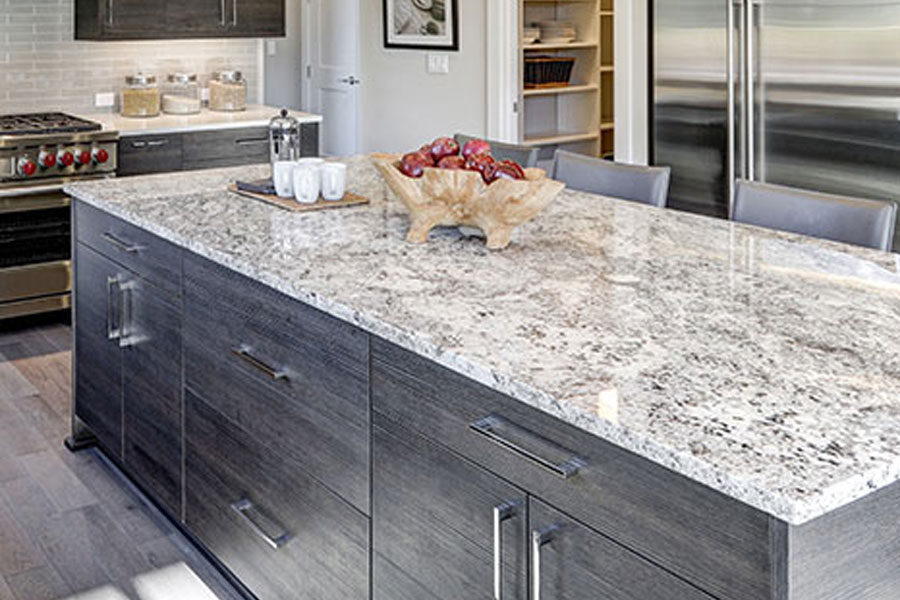
The most repeated selling point about quartz countertops is wrong: quartz is not heatproof. The stone in it shrugs off heat, but the polymer resin that binds a quartz slab together starts to soften and discolor around 150°F, and a pan off the stovetop runs 300°F to 500°F. That single fact reshapes the whole quartz-versus-granite-versus-laminate decision, because the right countertop is the one that fits how you actually cook, clean, and spend. This guide walks all three materials through the things that decide a kitchen: heat, scratches, sealing, hard water, and cost. When you want to see and touch the options, our countertop selection covers granite, quartz, and laminate under one roof.
Quartz vs Granite vs Laminate: The Short Answer
The best countertop depends on your priorities, and each of the three wins a different homeowner. Quartz is the low-maintenance pick that never needs sealing. Granite is the natural-stone pick that handles a hot pan best. Laminate is the budget pick that has come a long way in looks. Here is the quick version before the detail.
Quartz never needs sealing and resists scratches best, but its resin binder can scorch under a hot pan.
Granite takes high heat better than either alternative and lasts for decades, and most granite does not actually need regular sealing.
Laminate costs the least and comes in the widest range of looks, but it can scorch, scratch, and chip more easily than stone.
All three are easy to live with in a hard-water kitchen if you wipe up standing water; quartz has the edge because it is non-porous.
How you cook matters more than the brochure: a heavy cook who sets down hot pans leans one way, a busy family that wants zero upkeep leans another.
What Are Quartz, Granite, and Laminate Made Of?
The three countertops are built in completely different ways, and that construction drives every difference that follows. Engineered quartz is roughly 90 to 94 percent ground natural quartz blended with a polymer resin that binds and colors it, then pressed under heat and pressure into a slab. That high quartz content makes the surface hard and non-porous, so nothing soaks in and there's no sealing to keep up with. The resin fraction is small, but it's the part that reacts to heat, and it's the reason a quartz slab and a granite slab behave so differently at the stove. Knowing which material is solid stone, which is engineered, and which is a printed surface tells you most of what you need before you ever start comparing colors.
Granite is natural igneous stone, cut from a quarried block, so every slab carries one-of-a-kind mineral movement. It is mostly feldspar and quartz, which makes it hard and heat-tolerant, and mildly porous, which is why sealing comes up in a granite conversation. Laminate is a printed decorative layer over a fiberboard core, topped with a clear wear layer. That build is what keeps laminate inexpensive and gives it endless patterns, and it is also why heat and deep scratches reach the core more easily than they do on stone.
Which Countertop Handles Heat Best?
Granite handles heat best of the three, because it's solid stone with nothing in it to melt. It forms deep in the earth under extreme heat, so a hot pot set on granite doesn't faze it, though a trivet is still smart insurance against thermal shock over years. Granite is the surface for a serious cook who forgets a trivet now and then.
Quartz is where the heat myth bites. The natural quartz in the slab resists heat on its own, but the resin holding it together can't: quartz surfaces are generally safe only up to about 150°F, and cookware straight off a burner or out of the oven runs 300°F to 500°F, well past that point. A pan set down bare leaves a yellow or brown scorch that doesn't buff out. Quartz is a fine choice for most kitchens, but it asks for a trivet every single time. Laminate is the least heat-tolerant of the three; a hot pan can blister or melt the surface layer, so it always needs a trivet or a hot pad.
Which Resists Scratches and Daily Wear?
Quartz resists scratches best, and mineral hardness explains why. Hardness is measured on the Mohs scale, a 10-point ranking geologists use where a higher-numbered mineral scratches every one below it. Quartz sits at 7, while ordinary steel lands around 4 to 4.5, so a kitchen knife dragged across a quartz counter can't cut it. Granite is close behind, since it is built largely from quartz at 7 and feldspar at 6, which is why stone counters stay smooth for decades of chopping and sliding.
Laminate plays a different game. Its surface is softer than stone, so a knife used directly on it will leave a mark, and that's the reason cutting boards matter more on laminate. Its clear wear layer does resist everyday scuffs and abrasion well, and modern laminate holds up to normal kitchen traffic far better than the material's old reputation suggests. The honest summary: stone shrugs off knives and grit, laminate needs a little more care, and quartz is the hardest of all.
Do These Countertops Really Need Sealing?
Quartz never needs sealing, and granite needs it far less often than most people think. Because engineered quartz is non-porous, liquids can't soak in, so there is no sealer to apply, ever. Granite is where the folklore runs ahead of the facts. The Natural Stone Institute, the trade association that sets care standards for the U.S. stone industry, is blunt about it: most granite countertops do not need to be sealed, though many still benefit from a quality sealer that adds a layer of stain resistance.
What sealing actually does is worth understanding before you worry about it. A stone sealer is an impregnator that makes granite more stain-resistant, not stain-proof, and a simple water-drop test tells you whether yours needs a refresh: if water beads on the surface the seal is working, and if it soaks in and darkens the stone, it's time. Wipe up spills after cooking and a sealed granite top rarely gives you any trouble. Laminate needs no sealing at all, since its surface is a solid plastic wear layer.
How Do They Hold Up to Central Nebraska Hard Water?
All three handle hard water fine day to day, and quartz has a slight edge because it's non-porous. Hard water is common across Nebraska: the U.S. Geological Survey counts 121 to 180 milligrams per liter of dissolved minerals as hard and anything above 180 as very hard, and much of the state's groundwater sits at or above that upper line. Those minerals are mostly calcium and magnesium, and they leave a chalky film or a white ring where a droplet dries. On non-porous quartz, that film sits on top and wipes away with a damp cloth. On granite the same film wipes off too, and a maintained seal keeps minerals from working into the stone around the sink. University of Nebraska-Lincoln Extension, which publishes guidance on the state's hard water, marks that same 180-milligram line, about 10.5 grains per gallon, as the start of very hard water.
Laminate is also easy to wipe clean of mineral spots, though standing water is the thing to avoid at its seams. If your home runs especially hard water and you want the full breakdown of how quartz and granite compare over years of it, we went deep on that in our guide to quartz and granite in hard water. For most Central Nebraska kitchens, hard water is a wipe-up habit rather than a reason to rule any of the three out.
Quartz vs Granite vs Laminate, Side by Side
Quartz wins on scratch resistance and zero upkeep, granite wins on heat and longevity, and laminate wins on price. Here's the head-to-head on what actually decides a countertop, drawn from how each material is built, so you can read down the column that matches your kitchen.
What matters in a kitchen | Quartz | Granite | Laminate |
|---|---|---|---|
Heat from pans | Resin scorches; always use a trivet | Best of the three; stone takes heat | Weakest; can blister or melt |
Scratch resistance | Hardest (Mohs 7); knives can't cut it | Very hard; decades of wear | Softer surface; use cutting boards |
Sealing | Never needs it (non-porous) | Most granite does not need it; sealer optional | Never needs it |
Hard-water spots | Wipes off; non-porous | Wipes off; keep sink area sealed | Wipes off; watch the seams |
Look | Consistent, engineered patterns | One-of-a-kind natural movement | Widest range of printed looks |
Repair | Hard to repair; very durable | Can be refinished by a pro | Swap the piece; not repairable |
Upfront cost | Higher | Higher | Lowest |
What Does Each Countertop Cost?
Cost tracks the material and the work more than the label on it. Laminate is the least expensive by a wide margin, which is why it is the go-to for a fast refresh or a phased remodel where you update counters now and plan the bigger project later. Quartz and granite sit in a similar, higher range, and where a stone job lands depends on the grade of the slab, the square footage, the number of seams and cutouts, the edge profile you choose, and the fabrication and installation.
The honest way to price your kitchen is to measure it, since two counters of the same material can differ a lot once edges and cutouts are counted. Spreading the cost is easy to arrange, and countertop financing can keep a stone upgrade from waiting. Whatever your budget, all three materials can look current; the choice is about how the surface has to perform, not whether it will look good.
Common Questions About Quartz, Granite, and Laminate
Is quartz or granite better?
Neither is universally better; they win on different things. Quartz is the pick for the lowest upkeep and the best scratch resistance, and it never needs sealing. Granite is the pick for the best heat tolerance and true one-of-a-kind looks, and most granite needs little or no sealing. A heavy cook who sets down hot pans leans granite; a busy household that wants zero maintenance leans quartz.
Can you put a hot pan on quartz?
No, you shouldn't set a hot pan directly on quartz. The resin that binds a quartz slab is only safe to about 150°F, while cookware off a burner or out of the oven reaches 300°F to 500°F and can leave a permanent scorch mark. Always use a trivet or hot pad on quartz. Granite handles a hot pan far better, though a trivet is still a good habit on any counter.
Does granite countertop need to be sealed?
Most granite countertops don't strictly need sealing, according to the Natural Stone Institute, though many benefit from a quality sealer that adds stain resistance. A quick water-drop test settles it for your slab: if water beads up, the seal is fine; if it soaks in and darkens the stone, reseal it. Wiping up spills after you cook does most of the protecting.
Is laminate a bad choice for a kitchen?
No, laminate is a sound choice when budget and looks lead your list. Modern laminate resists everyday scuffs well and comes in the widest range of patterns, including convincing stone looks. Its limits are heat and deep scratches, so it needs trivets and cutting boards, and its seams shouldn't sit under standing water. For a fast, affordable refresh, it holds up better than its old reputation.
Which countertop lasts the longest?
Granite and quartz both last for decades and outlive laminate. Granite can be refinished by a pro if it ever dulls, and quartz is extremely durable but hard to repair once it's damaged. Laminate has a shorter life and is replaced rather than restored, though a quality laminate top still serves a busy kitchen well for many years.
Choosing the Right Countertop for Your Kitchen
The right countertop is the one that matches how your kitchen really runs, so start with your habits rather than the sample board. If you cook hard and set down hot pans, granite forgives you. If you want a surface you never think about, quartz never needs sealing and resists scratches best. If budget leads or you are remodeling in stages, laminate gets you a clean, updated kitchen for less. Hard water and daily wear are manageable on all three with simple habits.
Seeing the materials in person settles most of these decisions in a few minutes, since the look and feel of a real slab tells you more than any spec. Bring your cabinet colors and a rough measurement to our showrooms in Kearney, Grand Island, or North Platte, and our designers will walk you through granite, quartz, and laminate for the way you cook and live. When you are ready to price it out, request a free in-home estimate and we will measure the space and lay out the options that fit your kitchen and your budget.


