

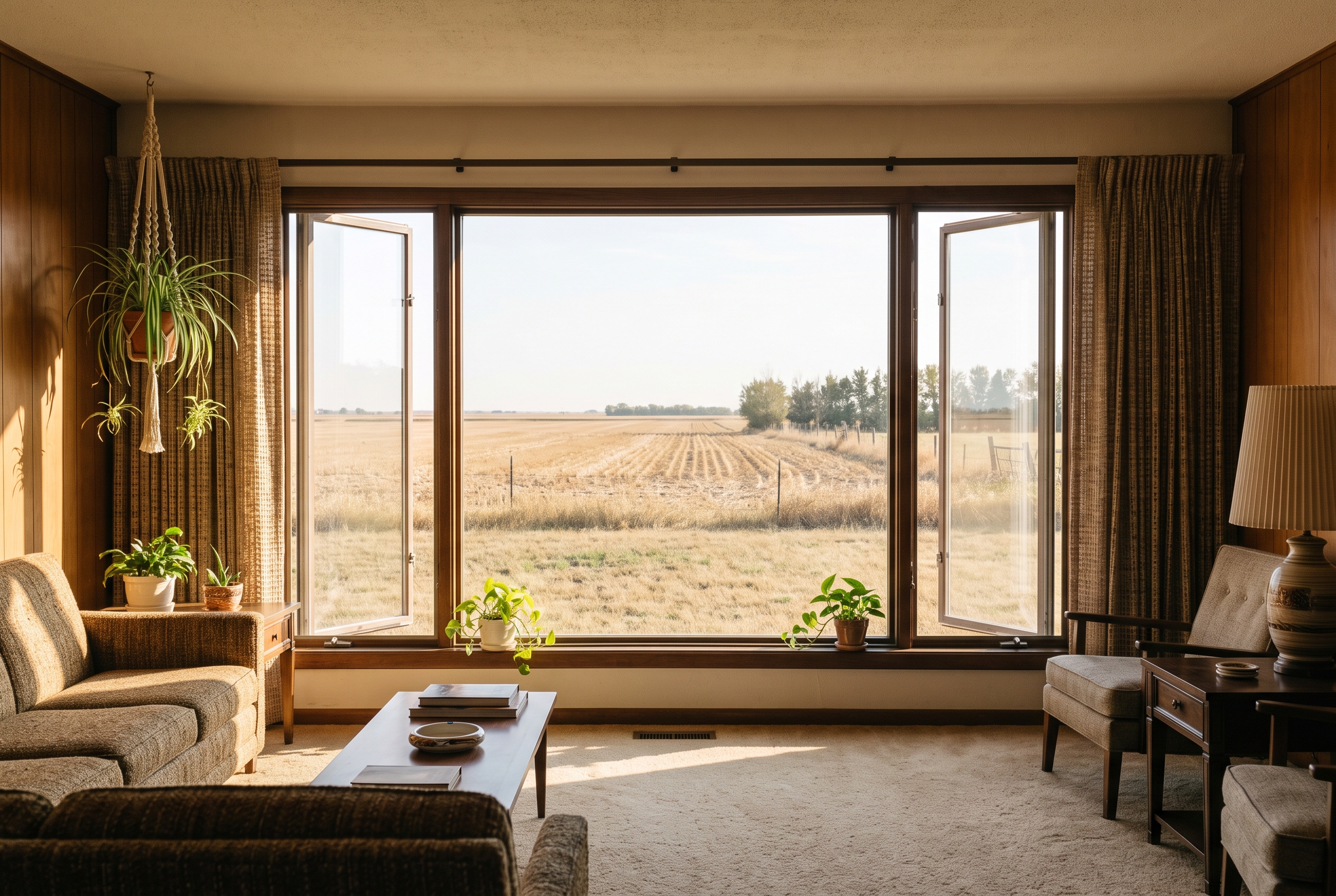
Every window style does one of three things. It slides, like double-hung, single-hung and sliding windows. It swings out on a hinge, like casement, awning and hopper windows. Or it stays shut, like picture windows and other fixed glass. Which style belongs in a room depends on how much fresh air you want there, how easily you can reach the window, and which way the wall faces.
Sliding styles fit almost any house and budget. They open only half their glass, so they suit rooms that need some air rather than a lot: bedrooms, living rooms, upper floors and wide, short openings.
Hinged styles open the whole sash and seal the tightest of any window that opens. They crank open with one hand, which makes them the choice over kitchen counters, for small egress windows in bedrooms, and high on bathroom and basement walls.
Fixed glass gives the most light and the tightest seal for the money. It never opens, so it goes where the view matters more than the breeze, usually beside a window that does open.
Bay, bow and garden windows push out from the wall. They add a seat, a shelf or a wider view, and they need support and insulation built in to stay warm.
| Style | How it opens | Best rooms | Watch for |
|---|---|---|---|
| Double-hung | Both sashes slide up and down | Bedrooms, living rooms, upper floors | Opens half its glass |
| Single-hung | Bottom sash slides up | First floors, rentals, tight budgets | Top glass cleaned from outside |
| Sliding | Sash slides sideways | Wide, short openings, basements | Track collects dust |
| Casement | Side hinge, cranks out | Over counters, small egress openings | Close it before high wind |
| Awning | Top hinge, cranks out | Bathrooms, basements, under fixed glass | Too small for egress |
| Hopper | Bottom hinge, tilts in | Basements, bathrooms | Lets rain in unless sheltered |
| Picture or fixed | Does not open | Views, stairwells, high walls | No air, no escape |
| Bay and bow | Several units project out | Living and dining rooms | Needs support and insulation |
| Garden | Glass box projects out | Kitchen sink wall | Top glass runs hot and cold |
How each window style opens, and why that matters
How a window opens decides how tightly it closes, how much of it opens, and which side the screen is on. A sliding sash, whether it moves up and down or side to side, glides along weatherstripping that has to let it move. A hinged sash swings out, and when you lock it, it is pulled straight against a rubber gasket, the way a refrigerator door closes on its seal. That is why hinged windows seal tighter.
Four words will make any window conversation easier. The sash is the part that holds the glass and moves. The frame stays fixed in the wall. The operator is the crank on a casement or awning window. A mull is the joint where two windows are joined into one unit, such as a picture window with a casement on each side.
The screen always goes on the side the sash does not swing through. Hinged windows swing outward, so their screens sit inside the room, and you work the window through the screen with the crank. Hung and sliding windows move inside the frame, so their screens sit outside.
Double-hung windows
A double-hung window has two sashes, and both slide up and down. It is probably the window you picture when you think of a house, and it suits traditional houses, bedrooms, living rooms and second floors. Most double-hungs made today let each sash tilt into the room, so you can wash the outside glass without a ladder.
Open both sashes a few inches and a stuffy room airs out on its own, with warm air leaving at the top while cooler air comes in at the bottom. This style also takes an ordinary window air conditioner.
The trade-off is that only half the window ever opens. On an older double-hung, the draft and the rattle usually come from the meeting rail, where the two sashes meet and the lock pulls them together.
Single-hung or double-hung
On a single-hung window, only the bottom sash moves and the top one is fixed. That makes it the lower-cost choice, with one less moving joint to wear. On a first floor, where you can reach the outside of the top glass, you give up very little.
Choose a double-hung on a second floor, in rooms where you want to vent from the top, and anywhere you would rather clean all the glass from inside. Single-hungs are a sensible choice for rentals and basements.
Casement windows
A casement window is hinged on one side and cranks outward like a door. Because the whole sash swings open, you get the full opening for air and for escape. When you lock it, the sash is drawn tight against its gasket, so it is one of the tightest-sealing windows that still opens.
An open casement also works like a scoop. Turned toward a breeze, the sash catches air moving along the wall and steers it into the room, so a casement often airs a room better than a larger hung window. Its screen sits inside, out of the weather. Because the hinges carry the whole sash, casements come in narrower widths than sliders, so a wide opening gets a pair of casements or a casement beside fixed glass.
Know two things before you choose one. It needs a special narrow unit if you cool with window air conditioners. And the sash stands out from the wall when it is open, so it should not open onto a deck or walkway, and it has to be cranked shut before a storm. The crank and hinges are the parts that wear, and both can be replaced.
Sliding windows
A sliding window has one or two sashes that move sideways in a track. It has few moving parts and is simple to work. That makes it a natural fit for openings wider than they are tall, such as basement windows and the long, low windows on a ranch house.
Like a hung window, a slider opens half its glass. Its weak spot is the bottom track, which collects dust, grit, dead bugs and, in a cold snap, ice. Sliders have small weep holes on the outside of the track to drain water.
Keep the weep holes open and vacuum the track a couple of times a year, and a slider keeps gliding for decades. For air conditioning, it needs the same narrow unit a casement does.
Awning windows
An awning window is hinged at the top and cranks out from the bottom. The open sash forms a little roof over the opening, so you can leave it open in a light rain. That is why it goes in bathrooms, over tubs, high on a wall for privacy, and in basements. It seals the same way a casement does.
Awnings are usually short and wide, so on their own they are rarely big enough to be a bedroom's egress window. They are often paired with fixed glass. A picture window with an awning under it gives the view and a breeze without a tall opening sash.
Hopper windows
A hopper window is an awning turned upside down. It is hinged at the bottom and tilts into the room from the top. It vents warm air high in a basement or bathroom and takes no room outside the wall, which helps in a window well. Because it opens at the top, rain can blow in unless the window is sheltered.
Picture windows and other fixed glass
A picture window is a large pane that does not open. With no sash to move and no seal to wear, fixed glass is the tightest window you can put in a wall. It is also the least expensive per square foot and gives the biggest unbroken view. The catch is obvious: no fresh air and no way out.
That is why a picture window is usually built as part of a group, between casements or double-hungs or over an awning. Use fixed glass where you want light or a view and nobody needs to open it: a living room facing a field or the lake, a stairwell, a high wall. A big west-facing pane takes the whole afternoon sun, so choose its glass with care.
Bay and bow windows
Bay and bow windows both project out from the wall. A bay is usually three windows set at angles, with a large fixed window in the middle and an opening window on each side. A bow uses four to six windows of the same width set in a gentle curve.
The wall and the look decide between them. A bay fits a narrower wall and gives an angled, traditional front. A bow needs a wider wall and reads as rounded, and it usually costs more than a bay of the same width because it has more windows in it.
Either one adds a seat or a deep shelf and pulls in light from three directions, which is why they end up in living and dining rooms. Because the window hangs out past the wall, it is carried by cables or brackets tied to a small roof above it.
Bays and bows have a reputation for drafts. When they are drafty, the cold comes from the seat and the top, not the glass. A well-installed one has rigid foam insulation under the seat and in the top, with spray foam sealing the gap around the unit. If you are shopping for one, ask how the seat and top will be insulated.
Garden windows over the kitchen sink
A garden window is a small glass box that projects out from the wall, usually over the kitchen sink. It has glass on the top and sides and a shelf for plants, and many have side panels that open for air. It brings more light to the sink than a flat window and gives herbs a sunny shelf.
Make sure the faucet clears the window and that you can reach the shelf across the sink, and think about which way it faces. The glass top gains heat on summer afternoons and loses it on January nights. A garden window on a north wall stays cool, and one on a south or west wall can cook delicate plants.
Specialty shapes, transoms and combination units
Specialty shapes, such as half-rounds, arches, quarter-rounds, octagons and trapezoids, are almost always fixed glass. They bring in light beside or over standard windows and finish a gable, an entry or a two-story wall. A transom is a short window set over a door or another window.
Combination units join styles in one frame, and they solve a lot of problems. Think of a picture window between two casements, a slider with a fixed panel, or a pair of double-hungs.
The windows in a house do not all have to be the same style. What makes a house look right from the street is consistency on each side. Keep the sash proportions similar, use the same grilles (the grid pattern between or on the panes) if you use any, and line up the window tops. Patio doors come in sliding and hinged versions too.
Which window style is most energy efficient
Fixed glass is the tightest, then casement, awning and hopper windows, then double-hung, single-hung and sliding windows. The Department of Energy ranks them the same way, because a hinged sash closes by pressing against the frame while a sliding sash needs room to move. Still, the style matters less than the glass, which is the most important energy choice in most windows.
So a well-built double-hung with good glass will beat a poorly made casement. Nearly every efficient window made today has two or three panes. A low-E coating, a thin metallic layer on the glass, does much of the work, and the same DOE guidance puts the energy it saves at 30 to 50 percent. Triple-pane glass lowers heat loss further and is worth asking about for the north and west walls that take our winter wind.
To compare windows of any style, read the National Fenestration Rating Council (NFRC) label on the glass:
- U-factor tells you how well the window keeps heat in. Lower is better, and in our winters it is the number that matters most.
- Solar heat gain coefficient tells you how much of the sun's heat comes through. Lower keeps a west or south room cooler in summer, and higher lets winter sun help warm the house.
- Air leakage tells you how much air gets past the closed window. Lower means fewer drafts.
- Condensation resistance tells you how well the glass resists fog and frost on the inside. Higher is better.
ENERGY STAR puts every county we serve, from Hall and Adams to Lincoln and Keith, in its Northern climate zone. Windows certified for that zone have a U-factor of about 0.22 or lower and an air leakage rating of 0.3 or lower. So the ENERGY STAR label for the Northern zone is a quick sign that the glass and seals are built for our winters.
Two more things decide how warm a new window feels. One is the installation, which has to be sealed and insulated all the way around the frame. The other is the weatherstripping, which wears with use, so a window is only as tight as its seals are years later.
The best window style for each room
For each room, ask how much air you want, how you will reach the window, and which way it faces. The answers point to a window style, and often to two styles in one opening.
Living rooms and family rooms
A living room usually wants a view and some air. That is why a picture window with a casement or double-hung on each side is the classic choice. If there is room outside and you want a seat, a bay or bow does the same job with more depth. On a west wall, pick glass with a lower solar heat gain number, or the room will bake by five o'clock.
Kitchens and the window over the sink
Over the sink, you reach across about 2 feet of counter, so choose a window you can open with one hand. A casement or awning cranks open without leaning or lifting, and a slider works if the opening is wide and short.
A double-hung over a deep counter is the hardest window in the house to open. Choose a garden window if you want light and plants more than air.
Egress windows for bedrooms and basements
Every bedroom needs an egress opening, almost always a window, that you can climb out of in a fire, and so does a basement. The International Residential Code, the model code behind most local residential codes, sets the size:
- At least 5.7 square feet of clear opening, or 5 square feet for a window at ground level or lower.
- At least 24 inches of clear height and 20 inches of clear width.
- A sill no more than 44 inches off the floor.
- It opens from inside without a key, a tool or special knowledge.
Clear opening means the open space you can climb through with the window opened as far as it goes, not the size of the window. A casement is the easiest way to meet the rule, because the whole sash opens. A double-hung or slider opens only about half its glass, so it needs a much bigger window to give the same clear opening.
A basement window that sits below ground needs a window well. The well must reach at least 36 inches out from the wall, be at least 36 inches wide and cover at least 9 square feet. If it is deeper than 44 inches, it needs a fixed ladder or steps.
The well also has to let the window open all the way, which matters with a casement that swings out. Your city or county building office decides what applies to your house, so check with them before you cut a new opening.
Bathrooms
In bathrooms, a window should give light and air without giving a view in. That makes an awning or hopper set high on the wall the usual answer, often with obscure glass, which is frosted or textured so it lets light through but blurs the view.
Glass in a wall beside a tub or shower, within 5 feet of it, has to be safety glass if its bottom edge is less than 60 inches off the floor or the tub. Plan for that when you price the window. A casement over a tub works only if you can reach the crank without standing in the tub.
Stairways, high walls and hard-to-reach spots
Where nobody can reach a window, use fixed glass or a shape. Glass beside stairs or a landing must also be safety glass when its bottom edge is less than 36 inches off the step. If a high window has to open for air, an awning is the safest choice, worked with a pole or a power operator.
Practical details that decide between two styles
When two window styles both fit a room, a practical detail usually settles it, and the most common one in our houses is the window air conditioner.
Window air conditioners
A casement cannot take an ordinary window air conditioner, and neither can a slider. A double-hung or single-hung can, because the unit sits on the sill with the lower sash closed down on top of it. Casements and sliders need a tall, narrow unit made for those openings, and there are fewer models to choose from. If your house runs on window units, keep a hung window in each room that gets one.
Screens, bugs and cleaning the outside glass
A tilt-in double-hung is the easiest window to clean, because both sashes tip into the room. A casement opens far enough to reach the outside glass through the gap at the hinge side. The top sash of a single-hung and the outside of fixed glass have to be cleaned from outside.
An inside screen, the kind casements and awnings have, stays cleaner and comes off for winter in a second. Outside screens on hung windows and sliders take the weather and the wasps. A crank-out window also needs a covering that clears the crank and handle, so choose the blinds or shades with the window.
Children, pets and window falls
A screen will not hold a child or a large dog. The Consumer Product Safety Commission advises window stops so windows open no more than 4 inches, or window guards that an adult can open quickly in a fire. It also advises keeping beds, dressers and toy chests away from windows.
The code asks for the same protection where a window sill is less than 24 inches off the floor and the ground outside is more than 6 feet down. On a bedroom's egress window, any stop or guard must release without a tool so the window can still open fully.
Older hands have a say too. A crank is far easier than lifting a heavy sash, so casements and awnings are a kind choice in the rooms an older parent uses.
Wind, dust and snow
In wind country, choose windows you can forget about, such as hung, sliding and fixed units, or get in the habit of closing casements and awnings when you leave. A strong gust of wind can catch an open sash and bend its arm or hinges.
Our dust is the reason slider tracks need vacuuming more often here than in town. In basements, snow is the issue. A casement in a window well has to swing past whatever is piled in the well, so keep the well clear, or covered in winter, if you count on it as your way out.
Locks and security
Casements and awnings are hard to pry open from outside, because the sash locks against the frame and the crank is inside. Hung windows and sliders rely on their locks. On a ground-floor slider or a basement window, a stop in the track adds a second line of defense. Where the glass is the weak point, such as beside a door, laminated glass holds together when it breaks.
Vinyl and other frame materials
Every window style comes in several frame materials, and for most houses here vinyl is the practical choice. Vinyl needs no painting, shrugs off moisture and insulates well. Wood insulates well and can be painted any color, but it needs upkeep unless it is clad. Fiberglass is strong and holds its shape.
Aluminum is strong and nearly maintenance-free but conducts heat, so in a cold climate it needs a thermal break, and today it is used mostly on commercial buildings. If your house still has its original aluminum sliders, much of the cold you feel comes through the frame itself, so moving to vinyl helps whichever style you choose.
Our residential line is Gerkin's Comfort Series vinyl windows and patio doors, from a regional manufacturer that has focused on energy-saving windows since 1932. For commercial buildings, Gerkin's Rhino series is aluminum.
What each window style costs, relative to the others
Window styles line up by cost in a fairly steady order. For the same size and glass, fixed windows cost the least, single-hungs a little less than double-hungs, and sliders about the same as hung windows. Casements and awnings cost more because of their cranks, hinges and locks. Bays, bows and garden windows cost the most, because they are several windows plus the structure, roof and trim around them.
Style is only one part of the price, and often not the biggest. The size of the opening, the glass, the frame material, the trim, any structural or egress work and the type of replacement move the number more. We measure every opening and give you a firm price at a free in-home estimate.
Changing window styles when you replace
You can change window styles when you replace, inside the opening you already have. A slider can become a casement with a fixed panel, a double-hung can become a casement, and a large single window can become a picture window with casements beside it. The hole in the wall stays the same size unless you cut it bigger, and that brings in carpentry, siding and drywall work.
A replacement goes in one of two ways. An insert goes inside the old frame, leaves the trim and siding untouched and costs less, but gives up a little glass. A full-frame replacement takes the window out to the framing, which lets you fix rot, insulate the gap properly and keep the glass size. A soft or rotted sill means full-frame.
In a bedroom, mind the egress rule. A replacement can stay the size of the old window only if it is the largest standard size that fits the opening and it opens at least as wide as the old one did. Swapping a casement for a double-hung in a small bedroom window can shrink the opening under what the code allows.
If you are still deciding whether it is time to replace at all, our page on window and door replacement walks through the signs and what a project looks like.
When a window starts giving trouble
Most window trouble comes from one worn part, and which part depends on the style. Find it before you decide the whole window has to go:
- A casement crank that is stiff, grinds or spins without moving the sash: clean the operator and spray its gears and pivots with silicone, not oil, which collects dust. Stripped gears mean a new operator, not a new window.
- A casement that will not pull tight: the hinges or lock need adjusting, or the weatherstrip has flattened.
- A hung sash that will not stay up or slams down: the balances in the side tracks are worn or have come loose.
- A slider that sticks or jumps: vacuum and wipe the track, give it a light silicone spray and check the rollers.
- Fog between the panes that you cannot wipe away: the sealed glass unit has failed and lost its insulating value. Sometimes the glass unit can be replaced alone; in an old window, it is usually time for a new one.
- A draft at a closed window: check the weatherstripping, the lock, and the gap between the frame and the wall.
When several of those show up in one window, or the frame itself is soft, warped or cracked, a repair only buys time.
Choosing windows with us
At CMH Interiors, we sell and install Gerkin windows and patio doors through a dedicated windows and doors department. Our specialists spent decades in construction and contracting before they joined us. Between Gerkin's residential and commercial lines, we cover horizontal sliders, casements, single- and double-hungs, awnings, hoppers and fixed windows, and we keep a well-stocked inventory so projects move on your schedule.
Come see the windows up close in one of our showrooms in Kearney, North Platte and Grand Island. A project starts with measuring and assessing each opening. You choose the style, glass and ratings with a specialist, matched to which way each window faces, and you get a firm quote. Once the windows arrive, a typical home is often done in a day or two.
You do not have to do the whole house at once. We help you plan a replacement in phases, starting with the north and west rooms that take the most wind and sun, and financing can spread a larger project into one plan. Our window treatment specialists work alongside the windows team so blinds and shades fit from day one. We are family owned, have served central and western Nebraska since 1999, and work from Ogallala to Hastings.
Questions people ask about window types
What window style suits a ranch house?
Long, low ranch-house walls suit sliders, pairs of single- or double-hungs, and picture windows flanked by casements. Keep the window tops in line along each wall, and the house will look finished from the street. Casements give a cleaner, more modern look, while hung windows and sliders keep the character of a 1960s or 1970s ranch.
What is the best window for a basement?
The best basement window depends on what it has to do. For a bedroom egress opening, a casement in a properly sized well is the easiest way to meet the size rule. For light and air high on a wall above the ground, a hopper or awning works well. For a wide, shallow opening, a slider is simple and lasts.
Which window style keeps out the most noise?
The tightness of the seal decides it, so fixed glass and hinged windows that lock against their gaskets keep out the most noise; sound slips through the same gaps air does. The glass and the installation matter as much as the style. Thicker or laminated glass and a frame sealed all the way around will quiet a room more than a change of style alone.
If you are planning room by room, walk the house with a notepad. Write down which rooms need air, which need an egress window and which face west, and bring that list to us. We will measure every opening, show you the styles side by side and price the whole house, or one room at a time, at a free in-home estimate.


