

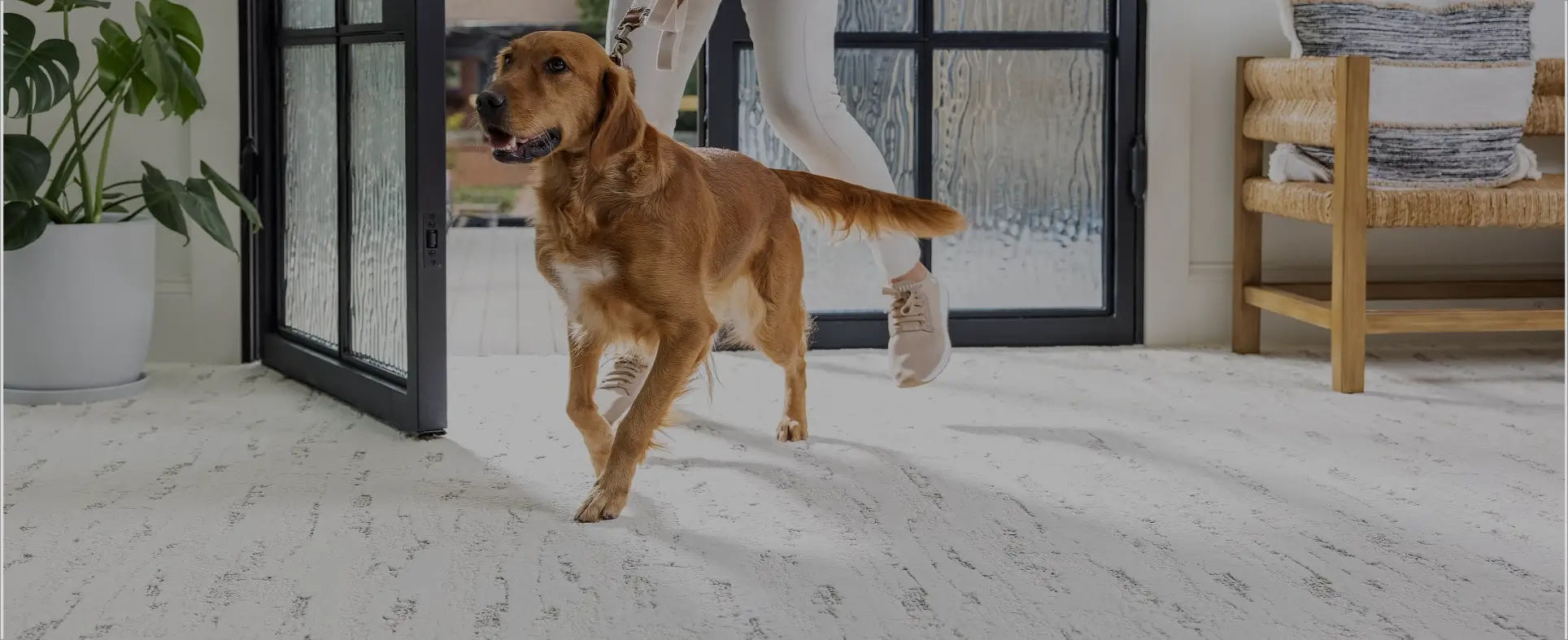
A dog lives in roughly 45 percent of American households and a cat in about a third, according to the American Veterinary Medical Association, the national body that tracks pet ownership. That is most homes. About 77.5 million of them keep a pet, which means most flooring decisions in Grand Island are really pet decisions, whether anyone says so out loud. The catch is that "pet-friendly" gets used as a vibe when it is actually a spec. A genuinely pet-proof floor comes down to four measurable things: a thick wear layer, a waterproof or water-resistant core, a hard enough surface, and, for carpet, the right fiber. Get those right and the dog's zoomies stop being a threat to your floors. This guide turns each one into a number you can shop with.
What Makes a Floor Actually Pet-Friendly?
A pet-friendly floor has to survive four specific things, and each one maps to a spec you can check. The four are scratches from nails and toys, water from bowls and accidents, easy cleanup of hair and muddy prints, and enough comfort and grip that a pet is steady on it. Most homeowners feel these as one fuzzy wish for a floor that can take it. Breaking them apart is what lets you compare products instead of guessing.
Scratch resistance comes from surface hardness and, on vinyl, from wear-layer thickness. Water resistance comes from the core: a waterproof plastic core shrugs off a spill that would swell a wood-based one. Cleanup comes from a smooth, sealed surface that hair and dirt sweep off rather than cling to. Comfort and traction come from texture and a bit of give underfoot, which keeps an older dog from scrambling. The floors that win pet homes are the ones that hit several of these at once, and the rest of this guide takes them one at a time.
How Thick Should the Wear Layer Be for Pets?
For a home with pets, a luxury vinyl floor should carry a wear layer of at least 20 mil, well above the 12 mil that suits an ordinary room. The wear layer is the clear protective top coat on luxury vinyl plank, and its thickness is measured in mils, where a mil is one-thousandth of an inch. A thin 6- to 8-mil layer belongs in a light-traffic room. It has no business under paws. A thicker wear layer puts more clear armor between a dog's nails and the printed design below, so it takes longer to scuff through to the pattern.
The industry rule of thumb lines up cleanly with real life. Flooring guides put 12 mil as the floor for ordinary residential use, 20 mil or thicker for homes with pets and active families, and 28 mil for commercial traffic. A 20-mil layer is thick enough to handle the grit a dog tracks in without wearing down to the pattern, which is why it is the sensible pet number. When you shop, the wear layer is often buried in the spec sheet, so it is worth asking for, and our full look at the best pet-friendly vinyl floor walks through what to check. You can also browse the luxury vinyl we carry to compare wear layers side by side.
Which Floors Resist Dog Scratches Best?
Tile resists dog scratches best, because a fired ceramic or porcelain surface is far harder than a claw. Hardness is ranked on the Mohs scale, a 10-point scale where a higher number scratches everything below it. The quartz-family minerals in a hard porcelain sit near 7, harder than the 4 to 4.5 of ordinary steel, while a dog's claw is soft keratin, so nails simply cannot mark a glazed tile. That is why tile is the default in the messiest, highest-traffic pet zones.
The other materials land in a clear order behind tile. Luxury vinyl with a thick wear layer resists nail scratches well and hides the fine ones a busy dog leaves, which is why it is the most popular pet floor overall. Laminate is scratch-tough too, and its surface durability is graded by the North American Laminate Flooring Association, the trade group that certifies laminate across four end-use levels and 14 performance tests covering wear, scratch, impact, and stain, with a heavier certification level meaning a tougher floor. Hardwood is the softest of the group underfoot: it looks beautiful, but a large dog's nails will leave fine scratches over time, so it wants a tough factory finish and regular nail trims if you love the real-wood look.
Which Floors Handle Accidents and Spills?
Waterproof luxury vinyl and tile handle accidents and spills best, because water cannot get into them. Luxury vinyl plank built on a rigid plastic core, sold as SPC or WPC, is waterproof through its thickness, so a water bowl that tips or an accident that sits until you find it wipes up with no swelling and no stain. Tile is equally waterproof, and porcelain is the extreme case: under the ANSI A137.1 standard the Tile Council of North America publishes, a tile only counts as porcelain if it absorbs 0.5 percent or less of its weight in water, which makes it effectively impervious. That is why tile is the surest choice right around bowls, back doors, and litter areas where water is a daily event.
The other two need more thought around water. Laminate is built on a wood-fiber core that can swell if water reaches the seams, so a pet home should choose a water-resistant laminate line and wipe up spills promptly. Carpet is the least water-friendly for pets, since liquids soak into the fibers and the pad, though the right fiber makes a real difference, which is the next section. For the rooms where mess is guaranteed, our tile selection is the low-worry answer.
Best Carpet for Pets: Why Fiber Matters
The best carpet for pets is one made from a fiber with built-in stain resistance, and triexta leads there. Triexta is a newer carpet fiber the Carpet and Rug Institute, the trade association for American carpet makers, recognizes as a primary residential fiber, and its stain resistance is built into the strand rather than sprayed on, so it does not wash out over the years of cleanups a pet home demands. That inherent resistance covers both water-based and oily spills, which is exactly the mix a dog or cat delivers.
Nylon and polyester each make a different trade. Nylon is the most durable and resilient carpet fiber, so it holds up to traffic and bounces back from crushing, but its stain resistance is a treatment applied at the mill that can fade with heavy cleaning. Polyester and its PET form are naturally stain-resistant and rich in color at a friendly price, though they crush sooner than nylon under heavy paws. For a bedroom or a low-traffic room where you still want softness, a pet-grade carpet works well; our carpet selection includes lines built for exactly this, and pet-oriented ranges like Shaw's Pet Perfect are made with these fibers in mind.
Comfort and Traction: The Part People Forget
Traction matters as much as toughness in a pet home, because a slick floor is hard on a dog. A glossy, smooth surface sends an excited or aging dog skating, and over years that scrambling stresses hips and joints. A floor with a little surface texture, like a matte, embossed luxury vinyl or a textured tile, gives paws something to grip and keeps a dog steadier on stairs and in hallways. This is the detail that separates a floor a dog is comfortable on from one it fights.
Softness is the other side of comfort, and it is why many pet homes keep some carpet. Pets spend a lot of the day lying on the floor, and a soft surface in a bedroom or a den is easier on old joints than tile or plank. A common setup pairs the two: hard, waterproof flooring through the traffic and mess zones, with a comfortable carpeted room or two where the pet rests. You get grip and cleanup where you need them and softness where the pet actually settles.
Luxury Vinyl vs Tile vs Laminate vs Carpet for Pets
Waterproof luxury vinyl is the best all-around pet floor, tile wins the mess zones, laminate is the value pick, and carpet earns the quiet rooms. Here is how the four stack up on what a pet actually tests.
What a pet tests | Luxury vinyl | Tile | Laminate | Carpet |
|---|---|---|---|---|
Scratch resistance | Strong with a 20-mil wear layer | Best; harder than any claw | Strong; pick a higher certification | Not the point; fibers crush |
Water and accidents | Waterproof (SPC/WPC core) | Waterproof | Water-resistant lines only | Soaks in; choose the fiber well |
Cleanup | Wipes and sweeps clean | Easiest; wipes clean | Sweeps clean; blot spills fast | Vacuum often; treat spots |
Comfort and traction | Warm, textured, good grip | Hard and cool; texture helps | Firm; texture varies | Softest; best for resting dogs |
Best rooms | Whole-home main floors | Entries, kitchens, bowl zones | Budget main floors | Bedrooms, quiet rooms |
How to Set Up a Pet-Friendly Home
The most livable pet home usually mixes floors by room rather than picking one for the whole house. We help pet owners do this every week, and the pattern that works is simple: run waterproof luxury vinyl through the main living areas and hallways where pets travel most, use tile in the entryways and around bowls where water is a daily thing, and keep a soft, pet-grade carpet in the bedrooms where the dog sleeps. That gives you cleanup and durability where the action is and comfort where it counts.
Getting the floor installed right matters as much as choosing it, especially with waterproof plank, where a flat subfloor and proper transitions keep water out at the edges. Our professional flooring installers handle that prep and the transitions between rooms so a mixed-floor plan reads as one home rather than a patchwork. Bring your pets into the conversation, literally or just in the details, and we will match the products to the way your household actually lives.
Common Questions About Pet-Friendly Flooring
What is the most pet-friendly flooring?
Waterproof luxury vinyl plank is the most pet-friendly flooring for most homes. With a 20-mil wear layer and a rigid waterproof core, it resists nail scratches, shrugs off spills and accidents, wipes clean, and gives paws better grip than a glossy floor. Tile is an even tougher and more waterproof option for entryways and bowl areas, while carpet with a stain-resistant fiber suits bedrooms.
What flooring is best for dogs that scratch?
Tile is the best floor for dogs that scratch, because a fired porcelain or ceramic surface is far harder than a claw and simply will not mark. If you want a warmer, wood-look floor, luxury vinyl with a 20-mil wear layer or a higher-certified laminate resists nail scratches well and hides the fine ones. Solid hardwood is the most scratch-prone of the popular options.
Is vinyl or laminate better for pets?
Vinyl is generally better than laminate for pets because it is waterproof, while most laminate is only water-resistant. A waterproof luxury vinyl plank handles a tipped water bowl or an accident with no swelling, whereas laminate's wood-fiber core can swell if water reaches the seams. Laminate is still a strong, budget-friendly pet floor if you choose a water-resistant line and wipe up spills quickly.
What is the best carpet for pets?
The best carpet for pets is one made from triexta or another fiber with built-in stain resistance. Triexta's stain resistance is part of the fiber rather than a coating, so it lasts through years of cleanups, and it resists both water-based and oily messes. Nylon is very durable but relies on an applied stain treatment, and polyester is naturally stain-resistant but crushes sooner under heavy traffic.
Does pet-friendly flooring cost more?
Pet-friendly flooring does not have to cost more, since a thicker wear layer or a waterproof core is available across a wide price range. The bigger cost drivers are the square footage, the product line, and the installation, not the pet-friendly features themselves. Choosing a 20-mil wear layer or a water-resistant laminate is more about reading the spec than spending more.
Choosing the Right Pet-Friendly Floor for Your Home
The right pet floor is the one whose specs match your animals and your rooms, so start with what your pets actually do to a floor. A big dog with long nails leans toward tile and thick-wear-layer vinyl; a house full of water bowls leans waterproof; an older pet that needs a soft place to rest leans toward keeping a carpeted room. In most homes the answer is a mix, planned room by room, and that is the plan that stays looking good for years.
Seeing and feeling the options settles it quickly, and you can bring the specifics of your household to the showroom. Stop by our locations in Kearney, Grand Island, or North Platte, and our team will walk you through luxury vinyl, tile, laminate, and pet-grade carpet for the way your pets live. When you are ready to plan the rooms and price it out, request a free in-home estimate and we will measure the space and match the floors to your household.


