

Blinds are rows of slats you tilt to steer light, and shades are one piece of fabric you raise and lower. Which is right depends on the room. Three things decide it: how you want to control light and privacy, how much moisture and wear the room gets, and how much the window loses heat in winter or lets in sun in summer.
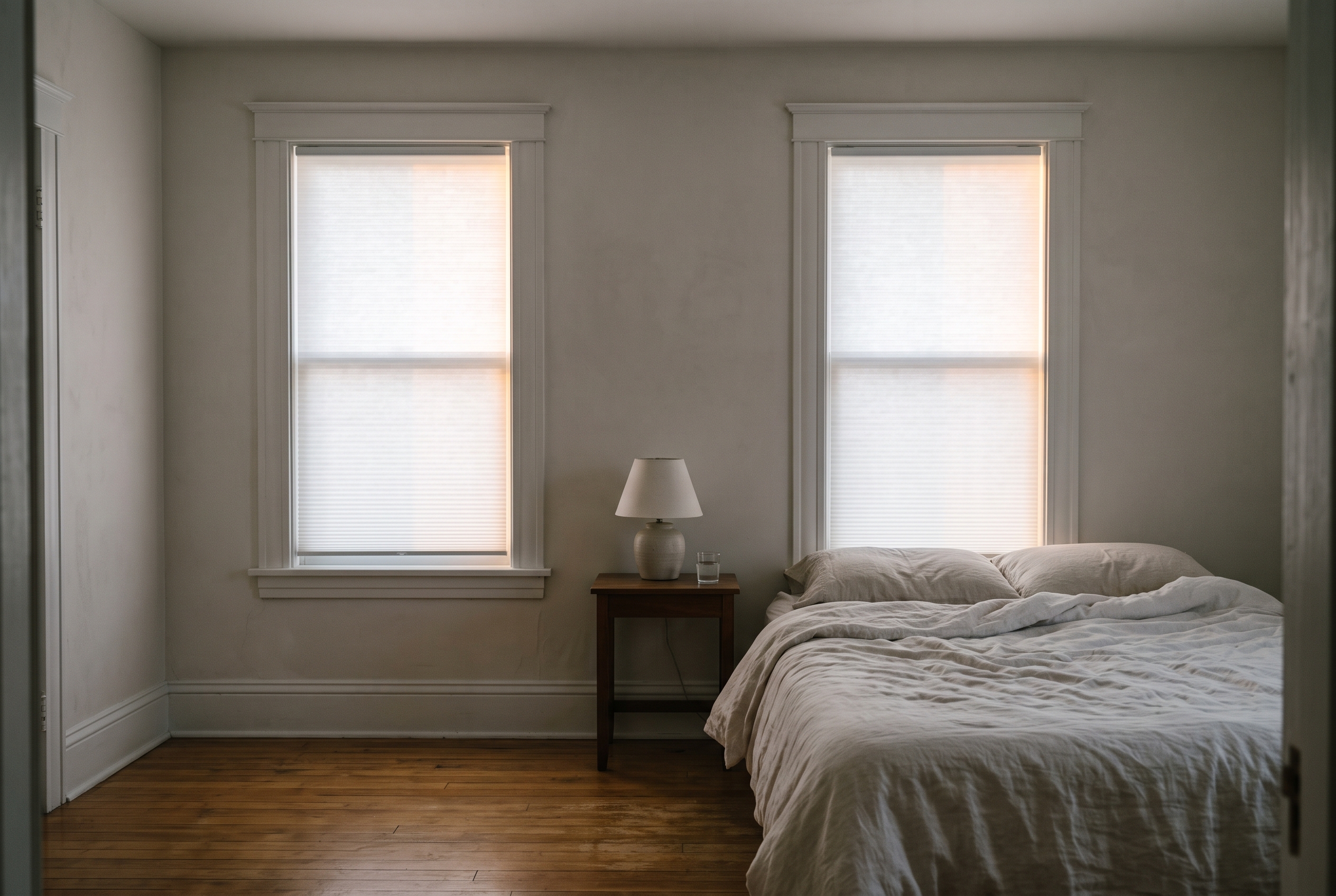
Bedrooms usually do best with shades, because a fabric shade with an opaque liner or side channels gets a room far darker than slats can.
Living rooms can go either way, depending on whether you want the classic look of wood or soft, filtered light with a view.
Kitchens and bathrooms favor faux wood or aluminum blinds, or a shade fabric made for moisture, because steam and splashes are hard on real wood.
Cold or sunny windows call for cellular shades. Their honeycomb pockets insulate better than any other common covering, on a north window in January and a west window in July.
In any room a small child uses, choose cordless or motorized, whatever the style.
| Room | Usual pick | What to ask for |
|---|---|---|
| Bedroom or nursery | Cellular or roller shade | Blackout fabric, side channels, cordless |
| Living room | Wood blinds or sheer shadings | Top-down option, motorizing big windows |
| Kitchen | Faux wood or aluminum blinds | Wipeable finish, cordless over the sink |
| Bathroom | Faux wood blinds or cellular shade | Moisture-safe fabric, top-down/bottom-up |
| West or south room | Cellular or solar shade | UV blocking, light-filtering fabric |
| Patio door | Vertical blinds or sliding panels | Stacks to one side |
The difference between blinds and shades
The difference between blinds and shades is how they handle light. Blinds have horizontal or vertical slats hung on cords or from a track at the top. You tilt the slats to aim light up, down or away, then pull the whole stack up or aside. Shades are a continuous piece of fabric that rolls, folds or stacks as you raise it, and how much light gets through is set by the fabric, from sheer to blackout.
Sheer shadings sit between the two, with fabric vanes that tilt like a blind. Shutters, hinged panels of louvers fixed to the frame, and drapery, hung from a rod, are the other two families, and drapery can layer over either a blind or a shade.
Types of blinds
Faux wood blinds suit most rooms with any moisture, real wood blinds suit living spaces, aluminum suits budgets and utility rooms, and vertical blinds suit wide sliders and patio doors. We carry both vertical and horizontal blinds.
Wood, faux wood and aluminum blinds
Real wood blinds are light for their size, which suits wide windows, and they insulate a little better than faux wood. They belong in living rooms, dining rooms and bedrooms, away from steam, because humidity and years of sun can warp or yellow real wood.
Faux wood blinds look like painted or stained wood but are made of a vinyl or composite that takes humidity. That makes them the choice for kitchens, bathrooms and laundry rooms, and they wipe clean with a damp cloth. They are heavier than real wood, so a very wide window may need two blinds side by side.
Aluminum blinds are the thinnest, lightest and least expensive, and they hold up in busy rooms, though their slats dent if a dog or a child bends them. Slat width changes the look: 1-inch slats read as mini blinds, and 2-inch or wider slats read as plantation style.
Vertical blinds for sliders and patio doors
Vertical blinds are the classic answer for a sliding patio door. The vanes stack to one side, so the door slides freely and you never walk through the blind, and they tilt for light and privacy like any blind. Sliding fabric panels on a track, sheer vertical shadings and vertical cellular shades move sideways the same way, and the cellular version insulates better.
Types of shades
Cellular shades are the ones for warmth, roller and solar shades for clean lines and sun control, Roman shades and woven woods for softness and texture, and sheer shadings for filtered light with privacy. In our showrooms, the Hunter Douglas lines we carry cover each family: Duette cellular shades, Vignette Roman shades, Provenance woven woods and Silhouette sheer shadings.
Cellular (honeycomb) shades
A cellular shade is two or more layers of fabric bonded into rows of hollow cells that look like a honeycomb from the side. The trapped air insulates, which makes cellular shades the warmest common window covering. They come with single cells or with a cell inside each cell, and the double-cell version is the one to ask for in a climate of weather extremes like ours.
Cellular fabrics run from sheer and light-filtering to room-darkening and blackout. A top-down/bottom-up version lowers from the top as well, for privacy with sky light, and select Duette styles carry an energy rating from the Attachments Energy Rating Council.
Roller and solar shades
A roller shade is a single panel of fabric that rolls onto a tube at the top. It gives the cleanest, simplest look and comes in everything from light-filtering to blackout fabric.
A solar shade is a roller shade made of a woven screen. It cuts glare and much of the sun's heat and keeps your view out by day, which makes it the go-to for west windows and TV rooms. At night it works the other way: with the lights on inside, people outside can see in, so in a street-facing room a solar shade usually pairs with a second covering.
Roman shades and woven woods
A Roman shade is fabric that folds into soft, stacked pleats as it rises, a tailored, softer look than a roller, and a lining adds privacy and darkness. Woven wood shades are made from natural wood, reeds, grasses or bamboo and bring texture to a room. Like any open weave, they need a liner if you want privacy at night.
Sheer shadings
Sheer shadings hang soft S-shaped fabric vanes between two sheer layers. Tilt the vanes open and you get filtered light and a hazy view with privacy in the daytime. Close them and the room goes private. They suit living rooms and street-facing windows where you want light all day without feeling watched.
Which controls light and privacy better
Blinds control the direction of light and shades control the amount, and that difference decides most rooms. With a blind, you can tilt the slats up so daylight bounces off the ceiling while nobody sees in, which a plain shade cannot do. With a shade, you choose the fabric's opacity once, from sheer to light-filtering to room-darkening to blackout, and raise or lower it.
At night the privacy picture flips. With the lights on inside, a light-filtering fabric or a solar screen shows your silhouette to the street, while closed slats or a room-darkening fabric do not. A top-down/bottom-up shade adds a third choice, lowered from the top for sky light with the lower half of the window covered.
Layering solves rooms that need both. A sheer or solar shade for the day with drapes or a room-darkening shade for the night gives full control, and drapery over a blind or shade softens the room.
Which keeps a room warmer in winter and cooler in summer
Cellular shades keep a room warmest in winter and do well in summer too. The U.S. Department of Energy reports that tightly fitted cellular shades can cut heat loss through a window by 40 percent or more in winter, about a tenth of a home's heating energy. In summer they can block up to 60 percent of unwanted solar heat, and shades that run in side tracks seal best.
Blinds do less in winter, because air moves through the gaps between the slats, but closed on a sunny window they cut summer heat and glare. Roller and Roman shades are chosen for privacy, darkness and sun control more than for insulation, and a heavier or lined fabric adds some warmth. Drapes closed at night cut a room's winter heat loss by up to a tenth, more if they hang close to the window and seal at the sides.
A tight, insulating shade has one side effect in our winters. With the shade closed, the glass behind it gets colder, and moisture from the house can fog or frost it. Leave the bottom rail about half an inch off the sill so a little air moves past the glass. Raise the shades during the day so the window dries, and run the bath and kitchen fans so indoor humidity stays moderate.
To compare products, look for that council's label. Its Cool Climate rating tells you how well a covering holds heat in, and higher is better for our winters.
Blackout options for bedrooms
For a truly dark bedroom, choose a blackout cellular or roller shade with side channels, the narrow tracks along each side of the window that the shade's edges run in. The other way is to mount the shade outside the frame so it overlaps the wall. Most of the light in a "dark" room leaks in around the edges, not through the fabric, so the mounting matters as much as the material.
Blinds cannot make a room fully dark, because light comes through the cord holes and between the slats. Closed faux wood blinds mounted outside the frame, with drapes over them, get a room dim, not black. Adding blackout drapery or side panels to any shade closes the last gaps, which is the answer for shift workers, nurseries and anyone woken by a June sunrise.
Moisture, dust and wear
In bathrooms, laundry rooms and kitchens, choose faux wood or aluminum blinds or a shade fabric rated for moisture, because steam and splashes warp real wood and stain some fabrics. Keep real wood blinds and fabric Roman shades away from the shower and the sink.
Dust is the other everyday difference. Blind slats collect dust on every flat surface and need a regular wipe, and on a gravel road or a windy day with the windows open that is a real chore. Fabric shades hold dust too but hide it, and a vacuum with a brush attachment takes care of them. With allergies, wipeable faux wood blinds or a smooth roller shade are the easiest to keep clean.
Pets and kids are hard on both. Dogs bend slats looking out the window and cats climb fabric. Faux wood slats stand up better than aluminum, and a top-down shade lets a dog see out the bottom of the window without wrecking anything.
Cordless and motorized coverings for kids and pets
In any home where small children live or visit, choose cordless or motorized blinds and shades. Loose cords can strangle a child, and the Consumer Product Safety Commission urges replacing corded blinds with cordless ones. Under the current safety standard, stock coverings sold off the shelf must be cordless or have short or out-of-reach cords. Custom coverings can still be ordered with cords, so ask for cordless.
Motorized shades, such as Hunter Douglas PowerView, run from a remote, a phone or a schedule. They solve tall and hard-to-reach windows, help anyone who struggles with a cord or a heavy shade, and can lower themselves on a hot west wall in the afternoon. If old corded blinds still hang in a child's room, replace them. Until then, keep cribs, beds and furniture away from the window and the cords wrapped high, where pets cannot chew them either.
Blinds or shades for each room
For each room, decide what you need most there, whether darkness, privacy with light, moisture resistance or warmth, and the choice between blinds and shades follows.
Living room windows
Living room windows usually need privacy with light during the day. Sheer shadings or top-down/bottom-up cellular shades give soft light and a view, and wood blinds give a classic look with tilt control. Across a wall of windows, keep every covering's top and bottom on the same line; motorization does that with one touch and makes big windows easy. A west-facing living room also needs the sun control covered under west windows.
Bedroom and nursery windows
Bedroom windows need darkness and warmth. A blackout cellular or roller shade with side channels or an outside mount, with drapes over the edges, is the usual answer. An east window matters most here, because a June sunrise comes well before most alarms. In a nursery or a child's room, the covering must be cordless or motorized, and the crib belongs away from the window.
Kitchen windows
Kitchen windows get steam, grease and splashes, so faux wood or aluminum blinds or a wipeable roller shade are the practical picks, and nothing fabric belongs right beside the range. Over the sink you reach across a counter, so choose a cordless lift or a motorized shade, and an inside-mount covering that clears the faucet and the window crank.
Bathroom windows
Bathroom windows need privacy without losing light. A top-down/bottom-up cellular shade in a moisture-safe fabric covers the lower window and lets light in from the top, and faux wood blinds tilted up do the same job. A window beside a tub or shower takes the most moisture, so faux wood is the safer choice there. If the window has frosted glass, a light covering is enough.
Home office and TV room windows
In a home office or TV room, screen glare is the problem, and the window behind or beside the screen is the one to treat. A solar shade cuts glare and keeps the view. Blinds tilted to bounce light off the ceiling keep daylight without reflections on the screen.
West- and south-facing windows
West- and south-facing windows overheat a room in the afternoon and fade whatever the sun reaches: floors, rugs and furniture. Floor makers, Shaw Floors among them, ask owners to keep direct sun off their floors to prevent fading, and a covering is the easiest way. Lower a cellular or solar shade for the afternoon hours, or set a motorized shade to do it on a schedule. Move rugs now and then so the floor ages evenly.
Matching the covering to the window
The window narrows the choice before the room does. Decide first between an inside mount, set within the frame for a built-in look, and an outside mount, set on the wall over the frame. An outside mount blocks more light and makes a small window look larger. An inside mount needs enough frame depth and leaves a thin line of light at the edges.
- Casement and awning windows crank outward, so the covering has to clear the crank and the lock handle. A slim cellular or roller shade usually fits, where a deep wood blind often does not.
- Sliders and patio doors need a covering that moves sideways or stacks out of the way: vertical blinds, sliding panels or a vertical cellular shade.
- Bay and bow windows take one covering per window, hung so the tops and bottoms line up around the bay.
- Tall picture windows and high windows are where motorization pays for itself, because nobody can reach the top.
- French doors and other glass doors need a shade mounted on the door, with hold-downs at the bottom so it does not swing.
- Arched and shaped windows can take a fixed shade cut to the shape, or the covering can stop at the straight part and leave the arch open.
If you are replacing windows, choose the coverings at the same time. Our window treatment and windows and doors specialists plan the two together, so the new shades fit the new frames.
What blinds and shades cost
Blinds and shades cost more the more custom, insulating and automated they get. Stock blinds in standard sizes cost the least. Custom blinds and roller shades come next, then cellular, Roman and sheer shadings, and motorization adds the most to any of them.
What moves the price is each window's size, the fabric or material, a custom fit, the lift system (corded, cordless or top-down/bottom-up), motorization, specialty shapes and the number of windows. Covering a whole room, or a whole side of the house, at once keeps colors and heights consistent. We measure every window and price your choices at a free in-home estimate.
Cleaning blinds and shades
Dust blinds and shades regularly and they rarely need more. For blinds:
- Close the slats one way and dust or vacuum with a brush attachment, then close them the other way and repeat.
- Wipe faux wood and aluminum slats with a damp cloth and a little mild soap when they need it.
- Keep real wood dry: dust it, wipe spots with a barely damp cloth, and dry it.
For shades:
- Vacuum gently with a brush attachment, working top to bottom.
- Blow dust out of cellular shades with a hair dryer on the no-heat setting.
- Spot-clean with lukewarm water and a little mild detergent, blotting rather than rubbing, because rubbing can damage the fabric.
- Never soak a fabric shade, and keep harsh cleaners off woven woods.
When a blind or shade needs fixing or replacing
A broken blind or a stuck shade usually comes down to one worn part, and many are fixable:
- Bent or broken slats: individual slats can often be replaced.
- A blind that will not stay up: the cord lock is worn or dirty.
- Frayed lift cords or broken ladder strings: the blind can be restrung, but in a home with children, replace a corded blind with a cordless one instead.
- A roller shade that will not catch or will not roll up: the spring tension needs resetting.
- A cellular shade that hangs crooked or sags: the cords inside need adjusting, which is repair work rather than a home fix.
- Yellowed, faded or water-stained fabric: time for a new shade.
- Mildew on a shade over a wet window: condensation is the cause, so fix the airflow first, then replace the shade.
Custom coverings usually carry a maker's warranty, and the paperwork that came with yours says what is covered.
Choosing window treatments with us
At CMH Interiors, we sell blinds and shades, including Hunter Douglas cellular, Roman, sheer and woven wood shades. Our team helps you choose and installs the Hunter Douglas treatments you pick, with cordless and PowerView motorized options for any room.
A good first step is our showrooms in Kearney, North Platte and Grand Island, where you can see fabrics in daylight and try how each one lifts and tilts. When you are ready, we measure the windows at your house, and financing can spread a whole-house order into one plan.
Questions people ask about blinds and shades
Are blinds out of style?
No. Wood and faux wood blinds remain a classic and suit traditional and farmhouse rooms. Shades read as softer or more modern, which is why many houses now mix the two: blinds in the kitchen and baths, shades in the bedrooms and living room.
Do all the windows in a house need the same coverings?
No, every window does not need the same covering, but the windows seen together from the street look best when they match from outside. Use the same color, or a white or neutral backing, on street-facing windows, and change the style room by room inside.
How long do blinds and shades last?
Sun, daily use and the parts decide how long blinds and shades last. Fabric on a west or south window fades first, cords and lift systems wear with daily use, and a well-made covering on a north window can look new for many years. Gentle cleaning and keeping the mechanisms working stretch their life.
Before you shop, count your windows, note which face west or south, and mark the rooms that need darkness or privacy. Bring that list in, and we will measure every window and show you the options side by side at a free in-home estimate.


